
Hearing aids
What Hearing Aids Are
A hearing aid is a small electronic device worn in or behind the ear that helps people with hearing loss hear better.
Hearing aids do not restore hearing to normal, but they help amplify sounds (make them louder) so the brain can understand them more easily. Children who do not pass a newborn hearing screening are referred to a pediatric audiologist to determine their level of hearing loss.
For newborns, the Automated Auditory Brainstem Response (AABR) test is often performed. For older children, the audiologist performs hearing tests in a sound booth and records the results on a chart called an audiogram. Based on these results, hearing aids may be recommended.
Most children wear behind-the-ear (BTE) hearing aids, while many adults prefer receiver-in-canal (RIC) hearing aids because they are smaller and more discreet. Hearing aids are commonly used for people with mild, moderate, or sometimes severe hearing loss.
How Hearing Aids Work
Source: https://my.clevelandclinic.org/health/treatments/24756-hearing-aids
Basic Parts of a Hearing Aid
A hearing aid has three main parts:
-
Microphone – picks up sound from the environment.
-
Amplifier (processor) – increases and adjusts the sound signal.
-
Speaker (receiver) – sends the amplified sound into the ear.
Other parts may include a battery, volume control, program button, etc.
Image source: https://audienhearing.com/blogs/hearing-test/do-you-need-a-hearing-aid
Hearing Aid Types
There are several types of hearing aids, including behind-the-ear (BTE), receiver-in-canal (RIC), in-the-ear (ITE), in-the-canal (ITC), completely-in-canal (CIC), and invisible-in-canal (IIC). BTE hearing aids are the most common for children because they are durable and powerful, while RIC hearing aids are very popular with adults.
Modern Features
Modern hearing aids use digital signal processing to reduce background noise, boost speech sounds, reduce feedback (whistling), and automatically adjust to different environments. Many also connect wirelessly to phones, TVs, and apps using Bluetooth.
Hearing Aid Brands
Major hearing aid manufacturers include Phonak, Oticon, Starkey, Widex, Signia, and ReSound, each using different sound-processing technologies.
Benefits and Limitations
Hearing aids can improve communication, social interaction, safety, and overall quality of life. However, they cannot restore natural hearing or eliminate all background noise, and most people need several weeks to adjust to them.
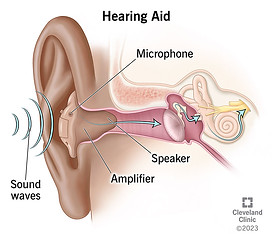
Hearing aids work by picking up sounds from the environment and making them louder.
First, a microphone captures sound and converts it into electrical signals.
Next, an amplifier (processor) increases the strength of the signal and adjusts the sound for the user’s hearing needs.
Finally, a speaker (receiver) sends the amplified sound into the ear canal. The sound then travels through the normal hearing pathway - the ear canal, eardrum, middle ear bones, and inner ear - so the brain can interpret it as sound.
Today, most newer hearing aids are digital, helping sound processing with microchips, adjusting to different environments, and improving speech clarity.