
About hearing loss
Facts about hearing loss
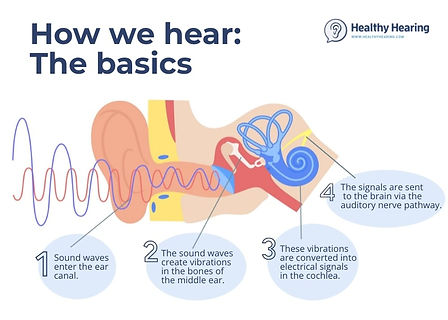
Source: https://www.healthyhearing.com/report/53241-How-we-hear-explainer-hearing
There are different types of hearing loss:
-
Conductive hearing loss, where issues s in the outer or middle ear prevent sound from efficiently reaching the inner ear (for example, earwax blockage, fluid, eardrum problems, or middle-ear bone problems). This type of hearing loss is often temporary and can be treated with medicine or surgery.
-
Sensorineural hearing loss, where damage to the inner ear (cochlea) or the hearing nerve occurs. This type of hearing loss is usually permanent. In children, causes are typically genetic conditions (from birth), certain medicines, or infections, such as meningitis.
-
Mixed hearing loss is a combination of conductive and sensorineural loss, meaning there are issues in both the outer/middle ear and the inner ear or nerve.
Hearing loss is also often described by:
-
Degree: mild, moderate, moderately severe, severe, or profound
-
Side: unilateral (one ear) or bilateral (both ears)
-
Onset: pre-lingual (before learning speech, often genetic and diagnosed at or shortly after birth) or post-lingual (after speech develops)
-
Progression: sudden or gradual, stable or progressive, fluctuating

Getting tested and getting the right support early is important.
-
Early diagnosis often leads to early support, helping with language development, friendships, and school success.
-
Children who receive early intervention before they are 6 months old are more likely to be ready for kindergarten than those who get help later.****
-
Early use of hearing devices (such as hearing aids or cochlear implants), as well as auditory therapy and parent coaching has been linked to higher language scores. (Selecting hearing devices and using verbal communication is each family preference)
Sources:
* https://www.nidcd.nih.gov/health/statistics/quick-statistics-hearing
** https://www.cdc.gov/hearing-loss-children/data/index.html
Getting a hearing loss diagnosis may be difficult and although it may feel overwhelming or upsetting, know that you are not alone!
Did you know?
-
About 2–3 out of every 1,000 children in the U.S. are born with hearing loss in one or both ears.*
-
Over 6,000 U.S. babies born in 2022 were identified with permanent hearing loss. That's about 1.7 per 1,000 screened.**
-
More than 90% of deaf children are born to hearing parents.*
-
Around 1.4% of U.S. school‑aged children (6–17 years) are deaf or have hearing problems.***